
Services
1. Business Incubator

What Is a Business Incubator?
A business incubator is a structured support program that helps early-stage startups turn ideas into viable businesses. Through mentorship, shared workspaces, and access to networks and funding, incubators create an environment where entrepreneurs can validate their business model and build a strong foundation for growth.
How It Works: Key Benefits & Process
Startups in an incubator benefit from reduced costs, expert guidance, and valuable networking opportunities. Programs typically include:
- Access to mentors and seasoned entrepreneurs
- Shared resources like offices, internet, and meeting spaces
- Workshops, investor introductions, and business development support
- Assistance with building an MVP and preparing for funding
Incubators often last 6–24 months, providing long-term support while helping startups navigate early challenges.

Laying the Groundwork for Growth
Joining a business incubator is the first step in your startup journey. It’s where you refine your vision, build traction, and prepare to scale. Once your foundation is in place, it’s time to accelerate.
Next up: the Business Accelerator—designed to help you grow faster and go further.
Types of startup
| Type of Startup | Description |
| Tech Startups | These companies focus on technological innovations, offering products or services that disrupt existing markets. |
| Biotech Startups | These firms work on groundbreaking medical and biological advancements, often requiring significant research and development. |
| Fintech Startups | Companies in this category innovate within the financial sector, providing new solutions for banking, payments, and financial management. |
| Edtech Startups | These companies aim to revolutionize the education sector through technology, offering digital learning platforms, educational software, and innovative teaching tools. |
| Healthtech Startups | These firms focus on using technology to improve healthcare delivery and patient outcomes, offering solutions like telemedicine, health monitoring devices, and medical software. |
| Greentech Startups | These companies develop environmentally friendly technologies and solutions, focusing on sustainability, renewable energy, and reducing environmental impact. |
| E-commerce Startups | These firms operate online marketplaces and platforms, transforming the retail sector by offering innovative shopping experiences and supply chain solutions. |
| Agritech Startups | These startups leverage technology to improve agricultural practices, including precision farming, supply chain optimization, and sustainable farming solutions. |
| Foodtech Startups | These companies innovate in the food and beverage industry, offering new products, sustainable food production methods, and advanced food delivery systems. |
| Traveltech Startups | These firms focus on enhancing the travel and tourism industry through technology, providing solutions for travel planning, booking, and experiences. |
lifecycle of a startup
A Business Incubator plays a critical role in supporting startups from the idea stage to business maturity, accelerating their growth through access to resources, mentorship, networks, and funding opportunities.
In the early stage, a startup begins by shaping a promising idea—sometimes sparked by sudden insight, but more often developed through deep exploration of a real-world problem with clear market potential. At this point, the incubator helps founders form a core team and supports the development of the initial product or prototype.
As the startup secures Series A funding, it enters the venture-funded stage, shifting focus from potential to performance. The incubator guides the company through key growth activities such as scaling operations, expanding the team, and building a sales strategy, while also preparing for future investment rounds.
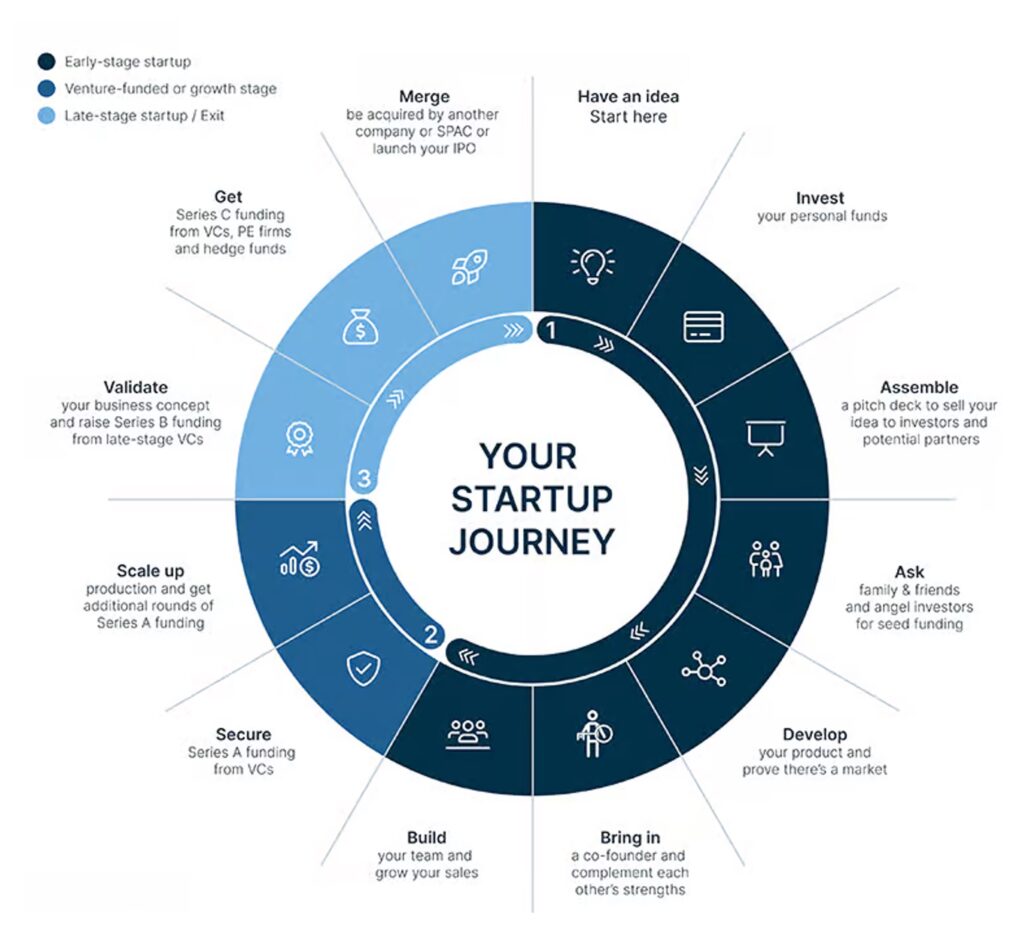
At the late stage, the startup has established financial stability and concentrates on sustainable performance. The incubator may support strategic initiatives such as product line expansion, entering new markets, or exploring acquisitions. During this phase, founders and investors often begin to consider exit strategies.
2. Business Accelerator

What Is a Business Accelerator?
A business accelerator is a structured, time-bound program designed to fast-track the growth of early-stage startups. Unlike incubators, accelerators focus on rapid development, helping startups refine their product, scale operations, and reach key milestones in a condensed timeframe. Programs provide mentorship, funding, and access to networks of investors and industry experts to accelerate success.
How It Works: Key Benefits & Process
Startups in an accelerator undergo an intensive program, typically lasting 3–6 months, which includes:
- Mentorship: Guidance from experienced entrepreneurs and industry experts.
- Workshops & Curriculum: Training in business strategy, marketing, fundraising, and product development.
- Networking: Access to investors, potential partners, and industry professionals.
- Resources & Demo Day: Tools, infrastructure, and the opportunity to pitch to investors at the end of the program.
These programs help startups scale faster, secure funding, and gain credibility, preparing them for rapid growth and market expansion.

Accelerating Growth and Preparing for Execution
Joining a business accelerator is the next step after validating your business in an incubator. It’s where startups gain momentum, expand their reach, and strengthen their market presence. After acceleration, the focus shifts to implementation—turning growth strategies into operational success.
Next up: Business Implementation—bringing your vision to life and scaling your startup effectively.
3. Business Implementation

What Is Business Implementation?
Business Implementation is the stage where your validated business model and growth strategies are turned into operational reality. It focuses on executing plans, building processes, and establishing the structures necessary to run a successful business. This stage ensures that your startup moves beyond ideas and acceleration into real-world performance.
How It Works: Key Steps & Support
During implementation, startups receive guidance to:
- Set Up Operations: Establish workflows, teams, and infrastructure.
- Launch Products & Services: Turn prototypes and MVPs into market-ready offerings.
- Scale Efficiently: Optimize processes to handle growth while maintaining quality.
- Monitor Performance: Use KPIs, metrics, and feedback to continuously improve.
Business Implementation bridges the gap between strategy and execution, ensuring that growth achieved in accelerators translates into sustainable results.

From Execution to Growth
Business Implementation transforms your startup from a rapidly growing venture into a fully functioning, scalable company. With solid processes, operational systems, and a focus on results, your business is ready to thrive in the market and seize new opportunities.
Next steps: After implementing effectively, your startup can continue to expand, attract investment, and explore new markets for long-term success.